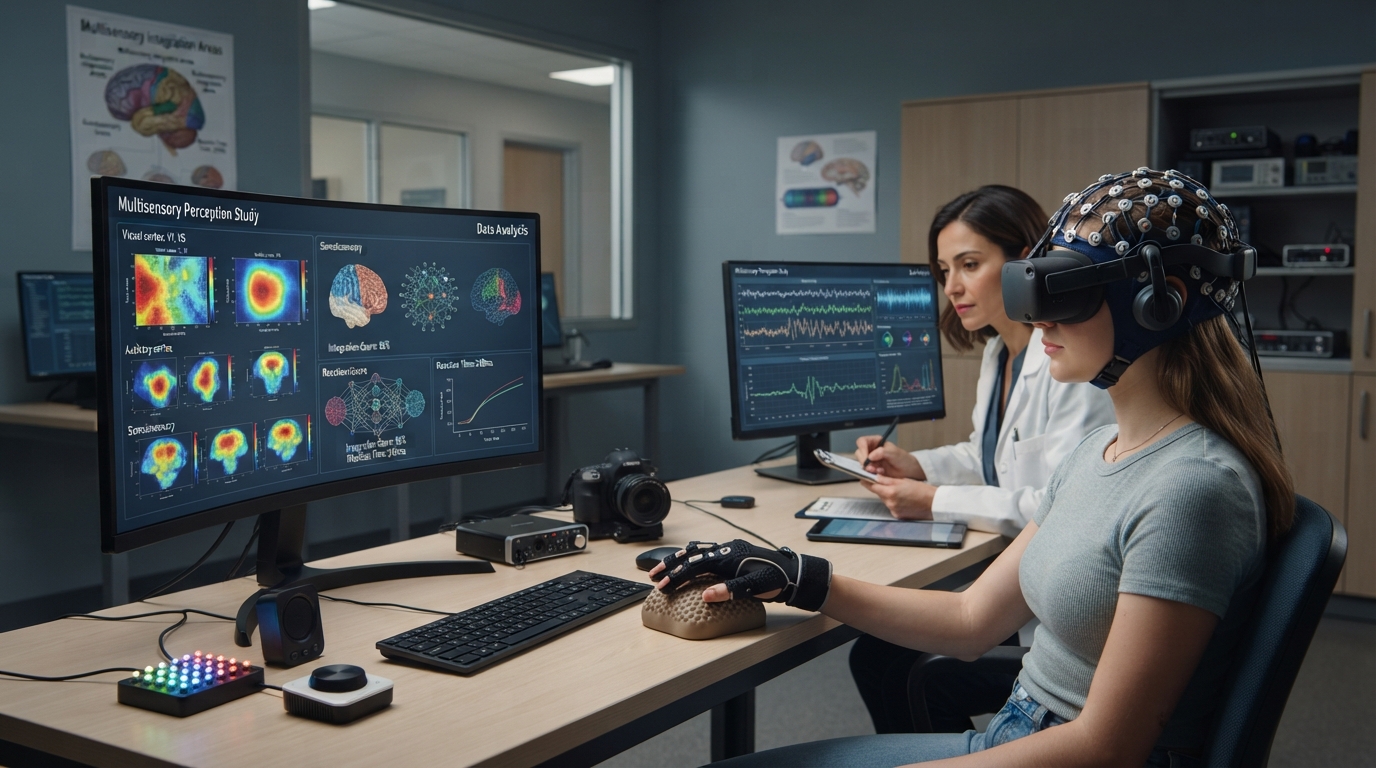
BEFORE FORM
Seeing seems the simplest thing in the world. We open our eyes and what surrounds us is already there: forms, colours, distances, objects, faces. Yet between the light that reaches our eyes and the world we recognise, an astonishing number of things take place.
Take a very familiar object and imagine it in the wrong place. A cup on the kitchen table belongs to the scene so naturally that it almost disappears into it; the same cup, suspended in the middle of an empty wall, immediately acquires another presence. Its form is unchanged, yet the way we look at it has shifted.
It is a tiny thought experiment, but it opens an enormous question: how much of what we see belongs to the object, and how much arises from the relationship between that object, its surroundings and what we bring with us as we look?
In everyday life, we rarely feel that we are constructing what we see. The world seems to present itself already organised: a figure emerges from its background, a room is immediately a room, we recognise one person among dozens and often grasp a face before their name has surfaced in memory. Everything happens with extraordinary fluency, and perhaps it is precisely this naturalness that conceals the complexity of the process.
Research into vision tells us something far more interesting than the story of a biological camera. The perceptual system receives an immense quantity of information and, as it processes it, some elements acquire priority while others remain in the background; what emerges depends on the characteristics of the stimulus, on what we are looking for and also on the history of our previous attentional experiences. In other words, looking always means looking somewhere, for some reason, with a history behind us.
The world always arrives with a context
Think how quickly we understand a scene.
We enter a kitchen and, before examining each element individually, already possess a general perception of the place. Table, sink, dishes and surfaces belong to a system of relationships we know very well; if something ambiguous appears beside the sink for an instant, the context helps narrow down what we expect it might be.
The same form placed on a studio desk immediately enters a different set of possibilities.
This is how we almost always encounter objects: among other objects, within places, inside situations that have their own logic. Decades of research into the relationship between objects and scenes have shown how strongly these relationships can facilitate or direct recognition; more recent studies also describe a partly parallel process, in which we can rapidly obtain general information about a scene while still processing the elements that compose it.
Experience of the world gradually makes us sensitive to these regularities. A street, a forest, a restaurant or a studio has configurations we have encountered many times, and that familiarity enters silently into the way we read them.
Here vision begins to lose photography’s apparent neutrality and starts to resemble a relationship far more closely.
We also learn where to look
Now imagine three people standing before the same painting: a conservator, a painter and someone entering an exhibition for the first time.
The work before them is the same. The light is the same. Yet it is entirely plausible that their eyes will follow different paths.
The conservator may be drawn to the surface, to craquelure, to an area where the material reveals something of its history; the painter may pause over a chromatic tension or the direction of a gesture, while another viewer may be captured immediately by a form that recalls something personal.
Precision matters here: scientific research does not give us a rule according to which different professions automatically see different worlds. It does, however, show very clearly that visual attention arises from the interaction between what is salient in the stimulus, the observer’s aims and their previous history of selection. Experience can therefore contribute to changing what receives priority as we look.
There is something deeply everyday about this idea. Someone learning to identify trees begins to distinguish differences that once seemed irrelevant; someone working with type suddenly discovers that letters have proportions, weights and intervals they had always seen without truly noticing; someone who spends years before painted matter develops a sensitivity to minute variations in the surface that gradually acquire meaning.
Experience does not simply add information to what we know.
It also educates the gaze.
When our eyes continue to insist on one thing and we know another
Visual illusions make all of this suddenly apparent.
There are situations in which we can know the physical reality of a stimulus perfectly well and continue to perceive it differently. Two elements may be identical and appear different; a physically vertical trajectory may seem inclined; a static structure may create an impression of movement.
What is fascinating is that knowing the trick often changes very little of what we see.
Patrick Cavanagh, who has studied vision for decades, proposes using illusions precisely as tools for tracing the emergence of perception. When what we know and what we see diverge, that fracture offers researchers a rare opportunity: to observe something of a process normally concealed by the ease of its result.
[VISUAL EXPERIENCE 01]
The Journal will present a real perceptual phenomenon, scientifically documented and accurately reproduced. First the image. Then a few seconds of observation. Only afterwards, the explanation.
Because reading that perception can diverge from a physical stimulus is interesting; noticing it happen in your own eyes is something else.
Expecting something changes how we encounter it
We also live in a world filled with regularities.
A handle generally appears in a particular relationship to a door; a cup has some orientations that are more probable than others; entering a bedroom, we expect a constellation of objects unlike the one we would expect in a railway station. Through thousands of experiences, we become sensitive to these probabilities, and the perceptual system can use context to make the recognition of scenes and objects more efficient.
One of the most influential ideas in contemporary cognitive science emerges from this territory: predictive processing, a family of models that seeks to understand perception partly through the interaction between sensory information and expectations or predictions.
It is a living scientific field, capable of organising many findings and still traversed by debates about mechanisms, interpretations and the scope of different theories. This is precisely why it becomes more interesting when allowed to retain its complexity: the popular image of a brain that “invents reality” is more spectacular, but tells us far less. Research into scenes and objects suggests instead a continuous, bidirectional interaction between incoming information and the regularities we have learnt from the world.
Seen in this way, perception has something dynamic about it: what we encounter continually changes what we know to expect, while what we have learnt participates in the way we meet what comes next.
A colour also lives in the colours around it
Colour perhaps offers the most immediate experience of this relational nature.
Take two squares of the same grey and place one against a light background and the other against a dark one. Knowing that the squares are identical does not necessarily prevent them from appearing different.
[VISUAL EXPERIENCE 02 · SIMULTANEOUS CONTRAST]
Something wonderfully simple happens here: to understand the appearance of a surface, the visual system uses spatial and contextual relationships. Perceived colour therefore arises partly from its relationship with what surrounds it.
For a painter, this reality is encountered directly in practice. One colour placed beside another changes its balance, intensity and apparent temperature; altering one area can perceptually transform what lies next to it, and a surface that seemed resolved can suddenly demand a new relationship.
Art and science arrive here by different routes. Perceptual research seeks to isolate variables, measure effects and understand the processes contributing to visual experience; painting enters those relationships and uses them, often long before there is any need to give them a name.
One seeks to understand how it happens.
The other allows us to experience that it happens.

Before form
Let us return, then, to the question with which we entered: what happens between what reaches our eyes and what we recognise?
Perhaps the most interesting answer is not a formula, because different processes coexist within that brief interval. The stimulus encounters a perceptual system capable of organising information, an attention that assigns priorities, a context that makes some interpretations more likely, a memory built through previous experiences and an organism that continues to learn from the world as it moves through it.
And almost always, we notice none of it.
We see a cup.
We see a face.
We see a room.
We see a colour.
The complexity of the process disappears behind the simplicity of the experience, and perhaps this is one of perception’s most elegant aspects: the work required to construct a coherent vision of the world normally remains outside our attention.
Every so often, however, something interrupts that transparency. An illusion resists what we know; a colour changes when its surroundings change; a familiar form suddenly becomes strange because it appears in an unexpected place.
For a few seconds, we stop looking only at what is before us.
We begin to see seeing.
Perception arrives before the name.