THE PRESENCE BEFORE THE NAME
Some images are recognised by the body before we can define them in words.
Some places reach us before we have had time to look at them properly. We enter and feel something. We may not yet know how to say what it is, and yet that first impression is already there. We call it atmosphere: a simple word for something born from the encounter between a place and everything we bring with us as we move through it.
There are rooms in which we lower our voices without thinking. In others we slow down, look for a window, or almost unconsciously choose a particular place to stop. Sometimes we understand at once what is guiding us: an unusually soft light, a very high ceiling, a sound arriving from far away. At other times the sensation comes all at once, and it takes a few moments before we begin to understand where it comes from.
It can happen on entering an empty church, a hotel lobby, a house we have never visited. It happens outdoors too: a street narrows and changes our pace; beneath a portico the sound of the city suddenly changes; then we step out of the shade and find the sky again. These are ordinary experiences, so ordinary that we often pass through them without stopping to think.
Yet they tell us something important about our relationship with places. When we enter a space, we do not encounter only what we see.
A place reaches us from many directions
Photography has accustomed us to knowing architecture primarily through our eyes. Before visiting a building, we may already have seen dozens of images of it, and perhaps we can recognise its façade, a staircase or a view long before we have been there.
Then we arrive and discover that almost everything was missing.
The sound of our footsteps was missing, for instance, as was the feeling of the floor beneath our shoes. We did not know the temperature of the air, the way a voice is absorbed or returned by the walls, or the smell of the materials. Above all, our body was missing from that space: the distance we must cross to reach a door, the need to raise our head beneath a very high ceiling, the sensation of moving from an intimate environment into one that suddenly opens out.
Research into multisensory perception helps us understand how closely these aspects are intertwined. Our senses do not work independently, and what we perceive through one channel can alter the way we interpret what arrives through another. Even thermal comfort, under certain experimental conditions, may be influenced by the visual characteristics of an environment; likewise, the soundscape contributes to our evaluation of a space.
When we enter a room, however, we do not experience each of these phenomena separately. No one thinks first about light, then temperature and finally sound. We receive them together, as we walk and almost automatically try to understand where we are.
Perhaps this is also why the atmosphere of a place is so easy to feel and so difficult to dismantle into its individual parts.
We can measure a great deal, and that matters
If we want to understand a space more fully, we naturally have many tools available. We can measure how much light enters and how it is distributed, record the temperature and humidity of the air, and study a room’s acoustics. We can observe proportions, understand how close a wall is to the body, or how an opening alters the perception of the environment.
These are real and valuable forms of information. Research into the built environment has long examined how some of these characteristics can affect comfort, attention, behaviour and the way we evaluate a space.
The interesting part comes when we try to put everything back together.
To study a phenomenon rigorously, it is often necessary to isolate it. If I want to understand the effect of a particular lighting condition, I need somehow to distinguish it from other variables. This is one of the principles that makes experimental research possible, but a real place does exactly the opposite: it presents everything simultaneously.
And meanwhile, we are moving.
This makes the study of architectural experience particularly fascinating and methodologically difficult. Some contemporary research is seeking to move closer to the conditions in which spaces are actually lived, because looking at a photograph of a room while sitting still before a screen is very different from entering that room and moving through it. Studies in neuroarchitecture likewise emphasise how movement and active exploration are important elements to consider when trying to understand our response to environments.
There is one thing a photograph cannot do
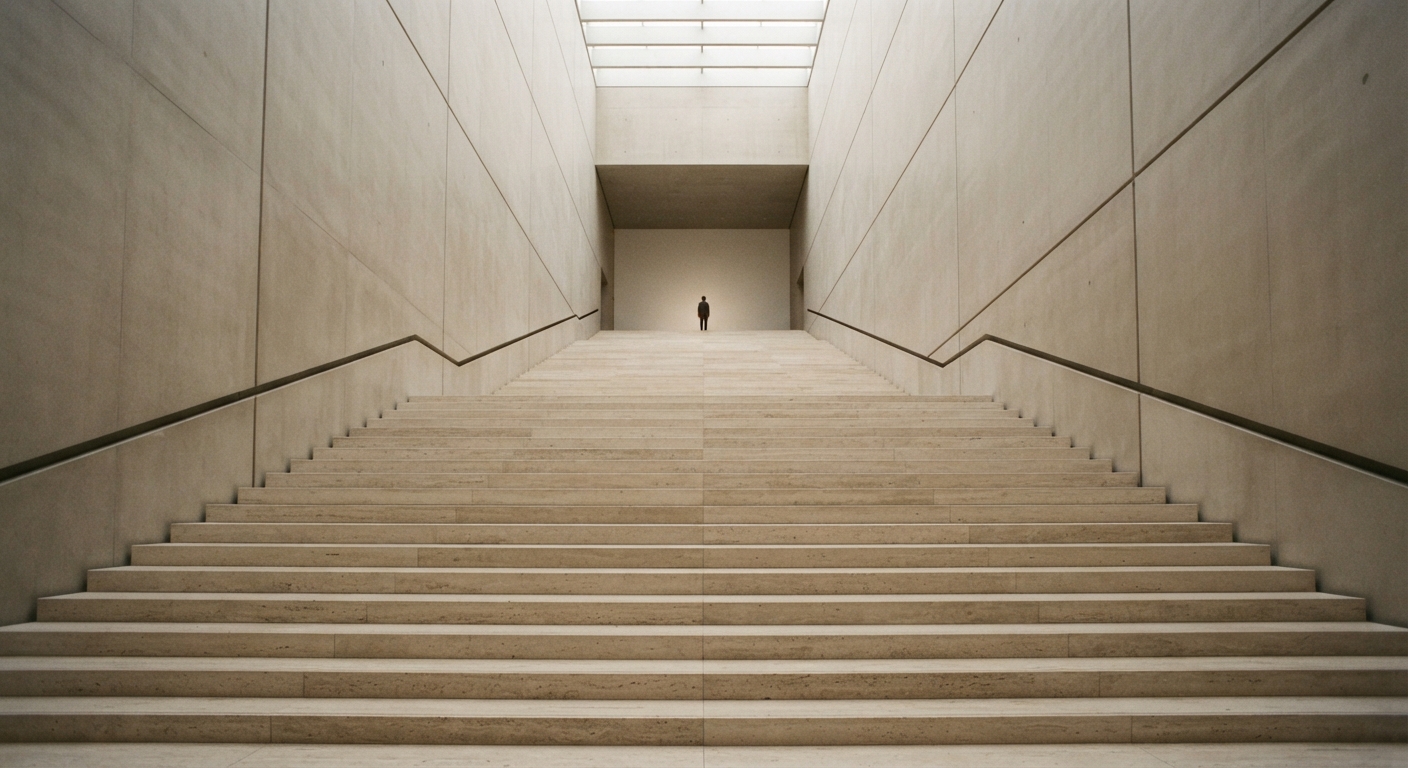
Think of a staircase.
We can photograph it beautifully and show its material, geometry and the light falling across the steps. We can even choose a viewpoint capable of conveying its monumentality remarkably well.
But the photograph does not contain the time required to climb it.
When we are there, that time becomes part of the architecture. We take the first step, slowly change level, what we saw from below disappears and something new enters our field of vision. We may hear voices from the upper floor before we see who is speaking. By the time we reach the top, the space we encounter has been preceded by everything that happened during the ascent.
The same is true of a corridor. On a plan it is a perfectly legible form; as we cross it, it becomes anticipation, distance, sound and movement. We watch the end draw closer and sense something of the next room before entering it.
The body knows a space in this way too, one step at a time.
It is a different kind of knowledge from that gained by observing it from outside.

We never enter a room alone
There is also a part of the experience that belongs even less to the building, because it arrives with us.
When we enter a place, we bring far more with us than we imagine. There are our memories, of course, but also other places we have known, images we have seen, habits formed over the years and many expectations that often become visible only when something surprises them.
A smell can return us to a house we have not entered for decades. A certain light may feel familiar before we understand why. Entering a large empty room, one person may perceive quiet while another senses distance; a material that carries the warmth of something known for us may have no particular association for the person beside us.
This does not mean every experience is arbitrary. The room is there, with its dimensions, materials, light entering from a particular direction and acoustics that can be studied. But we never enter it as a blank page.
We arrive with our body, with what we remember and with everything we have learnt by living, often without realising it. It is within this encounter that a place begins to take on a particular character for us.
It is also why we can return to the same place years later and find it different, even while knowing that almost nothing has changed. In the meantime, we have changed.
Before we can say it
Architects and philosophers have long considered that first overall impression we receive on entering an environment. Juhani Pallasmaa, in particular, has devoted an important part of his thought to the bodily and multisensory character of architecture, insisting on something easily recognised in our own experience: we often grasp the character of a place before consciously observing all of its elements.
It is important to understand the level on which we are speaking. This is not a neuroscientific measurement, but a phenomenological reading of experience: an attempt to describe what it means to live a space from within.
Scientific research can address other questions. It can study what happens when a lighting condition changes, observe how we respond to particular sounds, or test what changes when we are free to explore an environment rather than merely looking at an image of it.
These are different ways of approaching the same human territory, and they become especially interesting when each is allowed to do its own work. Science helps us understand some of the processes that participate in experience; phenomenology attempts to describe how that experience is lived.
And then there remains what happens to us when we actually enter.
That first sensation
We can now return to the room from which we began.
We entered, and something reached us before we knew how to explain what it was. If we remained there for a few minutes, we might begin to understand it better. Perhaps we would notice that the light comes from one side only, leaving part of the room more intimate. We might notice the particular sound of voices, or that the floor changes slightly beneath our steps. Perhaps we would recognise a familiar scent and suddenly understand why the place already seemed known.
We probably could not separate everything with precision, and perhaps we do not need to in order to recognise that the experience is real.
A place possesses matter, light, sound, proportions and history. We enter it with our senses, our movement, our memory and many expectations. Some come from our personal history, others from the culture in which we grew up, and many act before we even stop to think about them.
Atmosphere emerges from this relationship. We can design many of the conditions that contribute to creating it, study their various effects and understand ever more clearly how our body encounters an environment. Then comes the moment when someone opens a door and enters.
That is where all those conditions become an experience.
This is why some places can be photographed beautifully and still retain something the image cannot fully convey.
To know them truly, we have to be there.